Have you ever checked your watch while watching a sunset? Photographers do. Because from the moment the sun touches the horizon, a countdown begins: sometimes you have forty minutes, sometimes you have fifteen. Golden hour and blue hour give something the rest of the day can never give: light itself becomes part of the composition, entering the frame almost like a second actor. In this post, we examine the physics, history, and practical use of these two time windows together.
The Two Faces of Light: Why Are Some Hours "Magical"?
During the day, when the sun is directly overhead, light arrives vertically, harsh and colorless. Shadows are short and sharp, contrast is high, and skin tones often flatten out — but the moment the sun approaches the horizon, everything changes. Light now has to pass through a much thicker layer of the atmosphere. During this long journey, short-wavelength light (blue, violet) is scattered in every direction by molecules in the air and barely reaches our eyes; the remaining long-wavelength light (red, orange, yellow) reaches its target directly. This phenomenon is called Rayleigh scattering, and it is the fundamental mechanism that explains why sunsets turn red and gold.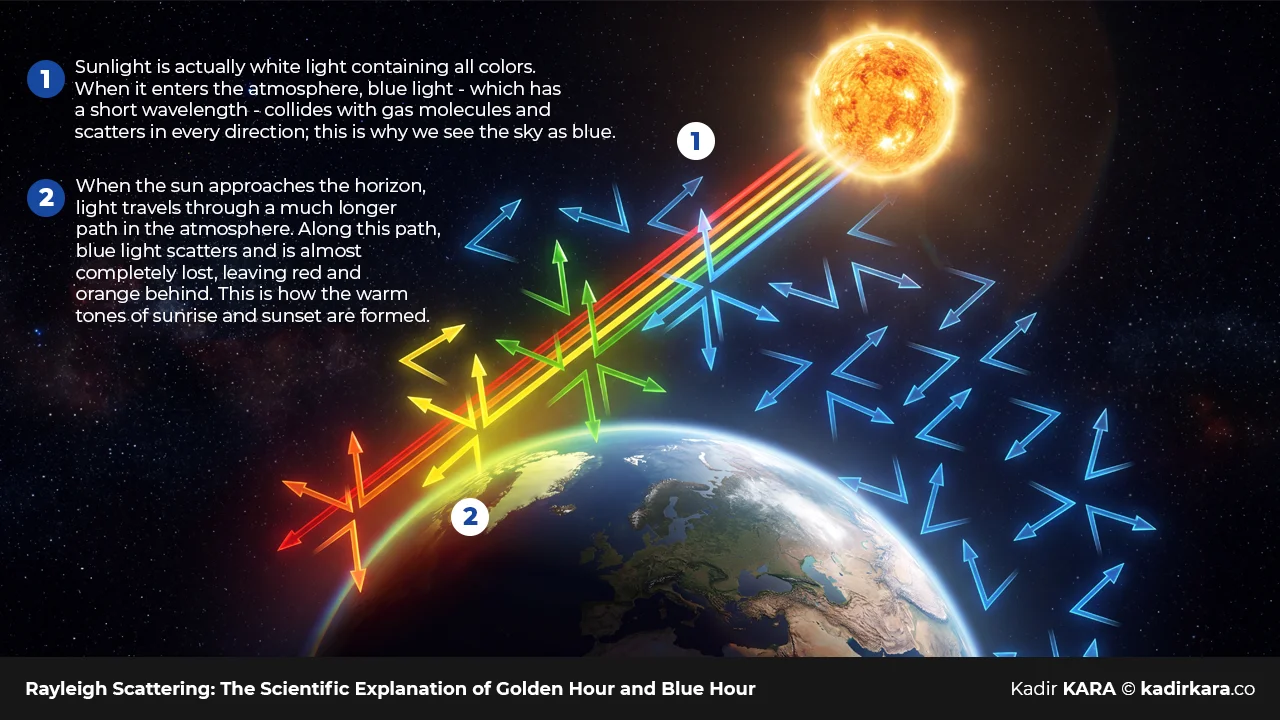
This is exactly what "golden hour" and "blue hour" are: two different phases of this same transition process, but two separate phenomena with different physical roots that should not be confused with one another.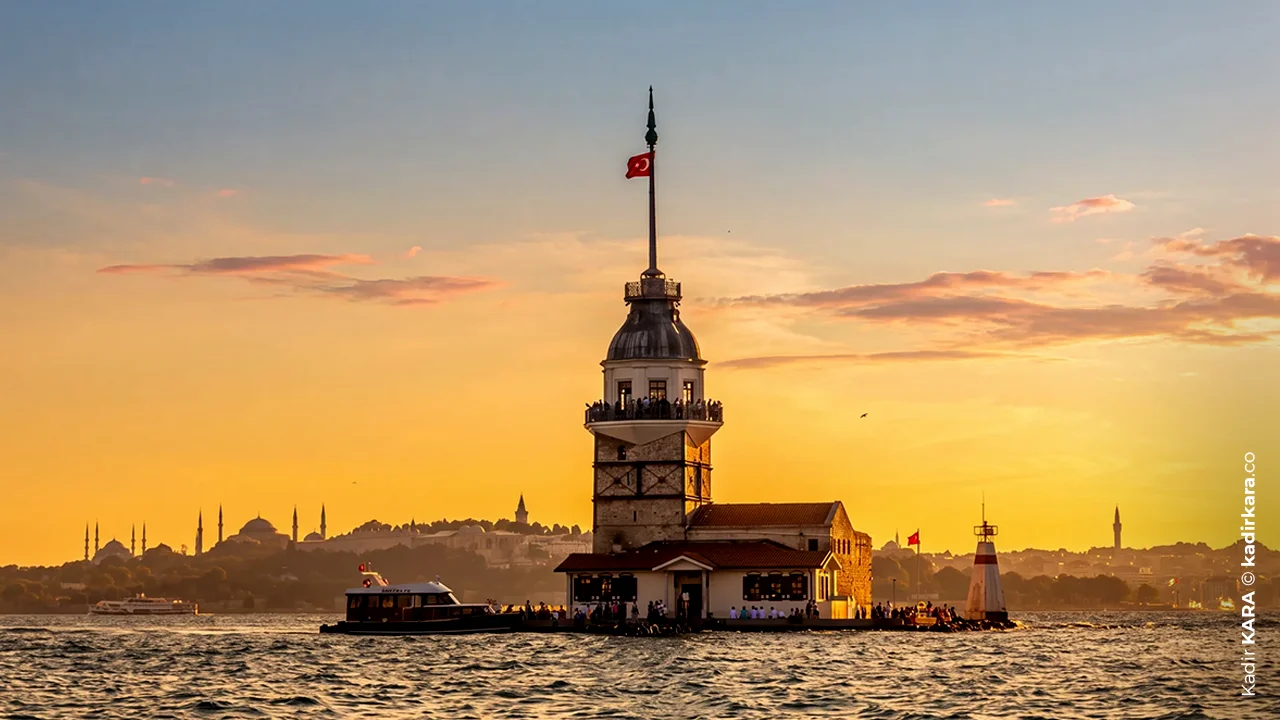
What Is Golden Hour?
Golden hour is the period when the sun is roughly between -6° and +6° relative to the horizon line. This definition also includes the moments when the sun has not yet risen or has just set, because even a sun sitting just below the horizon continues to paint the atmosphere red. During this window, the light is both low-angled and carries plenty of the red-orange spectrum. The result is soft, directional, "warm" lighting.
The duration of golden hour varies greatly depending on geographic location and season. In regions close to the equator, this window is short, because the sun sets at a nearly vertical angle to the horizon. Sometimes it doesn't exceed twenty minutes. As latitude increases, the window lengthens, because the sun approaches the horizon at a more oblique angle. For example, in a mid-latitude city like Los Angeles, one hour after sunrise the sun's elevation is still only around 10-12°. In regions near the polar circle, this effect can spread across almost the entire night during the summer months.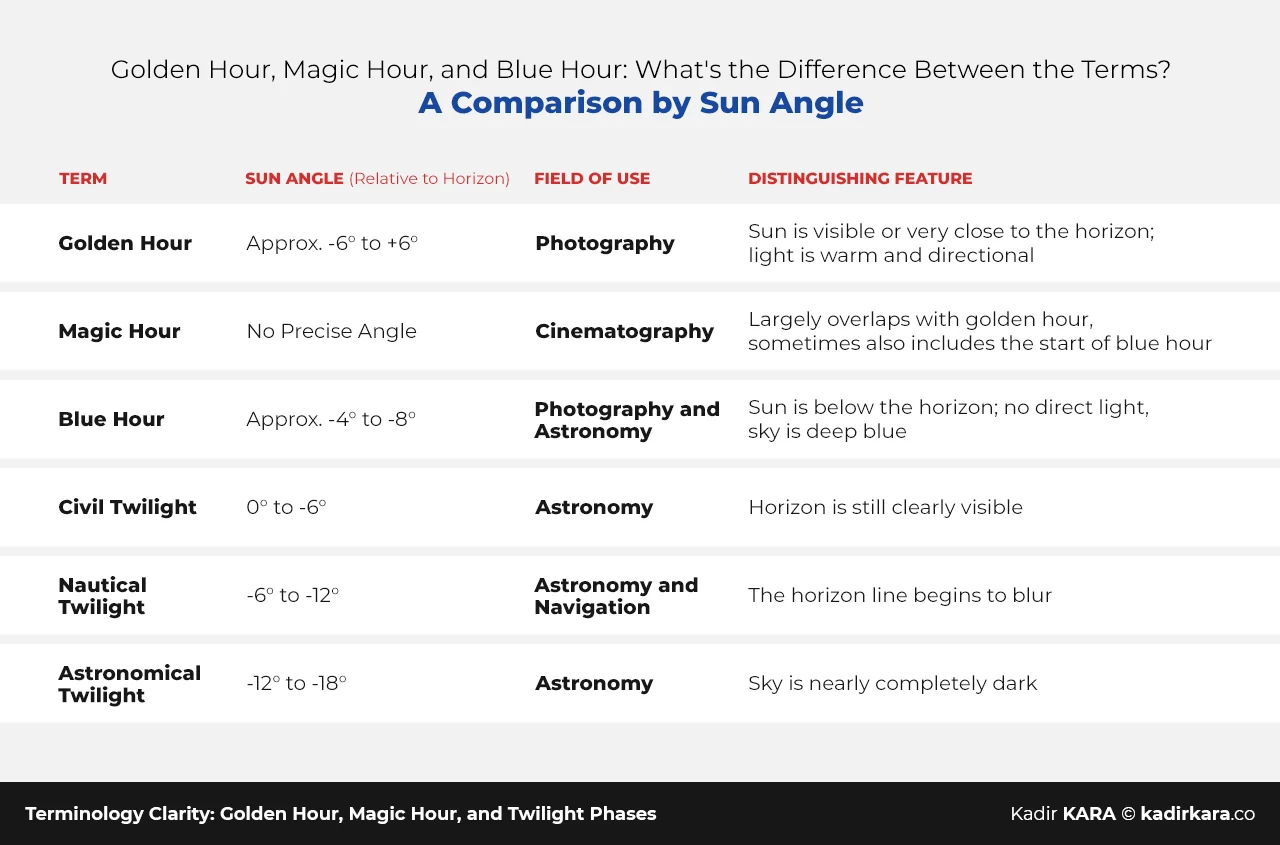
Photography Techniques for Golden Hour
The low-angle light offered by golden hour forms the basis of several classic techniques:
Silhouette
The light source is placed directly behind the subject; the subject enters the frame as a dark, solid shadow, while the background appears as a bright orange backdrop.
Backlight (Backlighting)
Despite a similar positioning to the silhouette, here the front of the subject also receives some light; the result is a soft glow around the hair and skin.
Rim Light (Edge Light)
The light illuminates only a thin edge line of the subject, while the rest of the surface remains largely in shadow.
Sun Flare
The camera is pointed directly at the sun; the light passing through the lens creates characteristic flare rings.
All of these techniques rely on the same physical fact: as the sun gets lower, its direction can be worked with, turning it into a controllable light source — something that is nearly impossible to do with midday sun.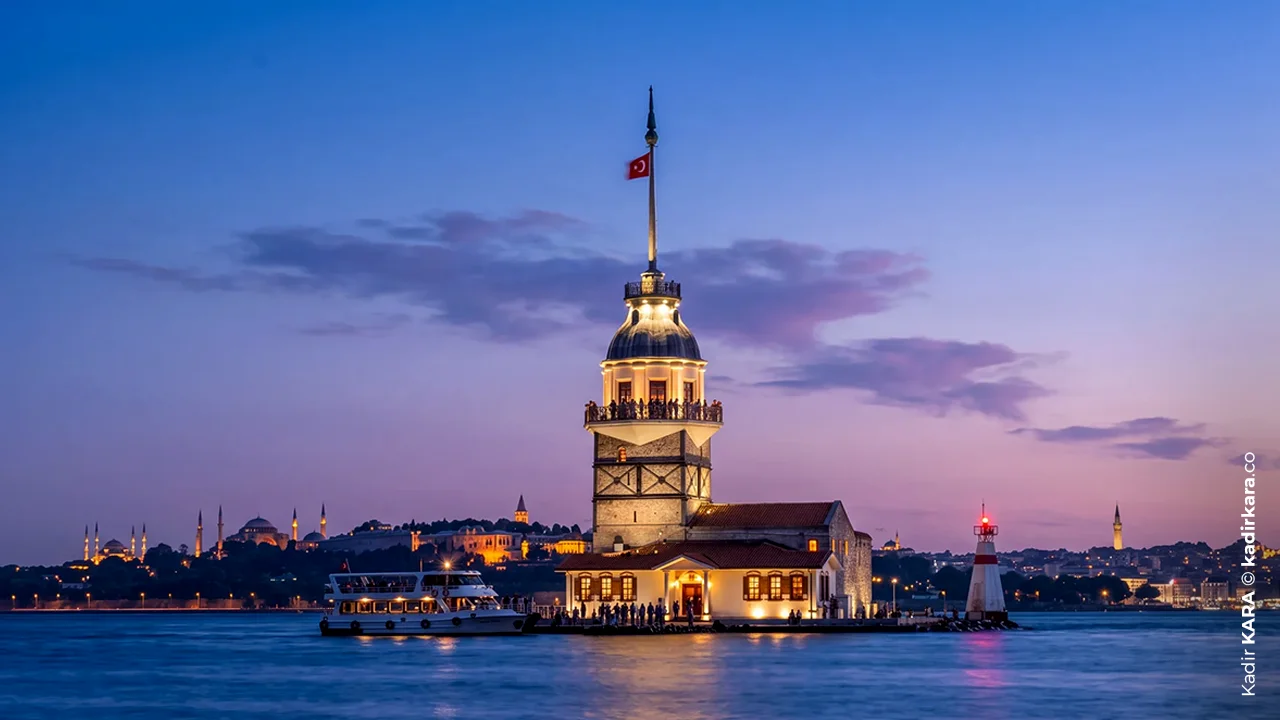
What Is Blue Hour?
Blue hour is the short window that appears when the sun drops to roughly 4° to 8° below the horizon. The mechanism at work here is not the same as the Rayleigh scattering that makes the daytime sky blue. While the sun is at this depth, the remaining indirect light passes through the ozone layer of the atmosphere. The ozone layer noticeably absorbs red light here (this is called Chappuis absorption), leaving predominantly blue wavelengths behind. In other words, the day's two different "blues" — the blue of the daytime sky and the blue of blue hour — actually arise from two separate physical processes.
Since there is no direct light source during this period, shadows almost completely disappear; light is distributed equally from every direction. Like golden hour, the duration of blue hour also depends on latitude. While it can last around 15-20 minutes in regions close to the equator, this duration can extend to 30-40 minutes around 50° latitude.
Photography Techniques for Blue Hour
Because blue hour presents a low-light condition, the approach differs from golden hour:
Tripod
A tripod is nearly mandatory, because exposure times stretch to several seconds.
Artificial Light Balance
Balancing with artificial light comes to the forefront: sources such as buildings, streetlights, or car headlights become nearly equal to the brightness of the sky — this is what makes blue hour ideal for urban and architectural photography.
Long Exposure
Extending the exposure time should be preferred over aggressively raising the ISO; otherwise, the subtle color transitions in the sky flatten out and noise increases.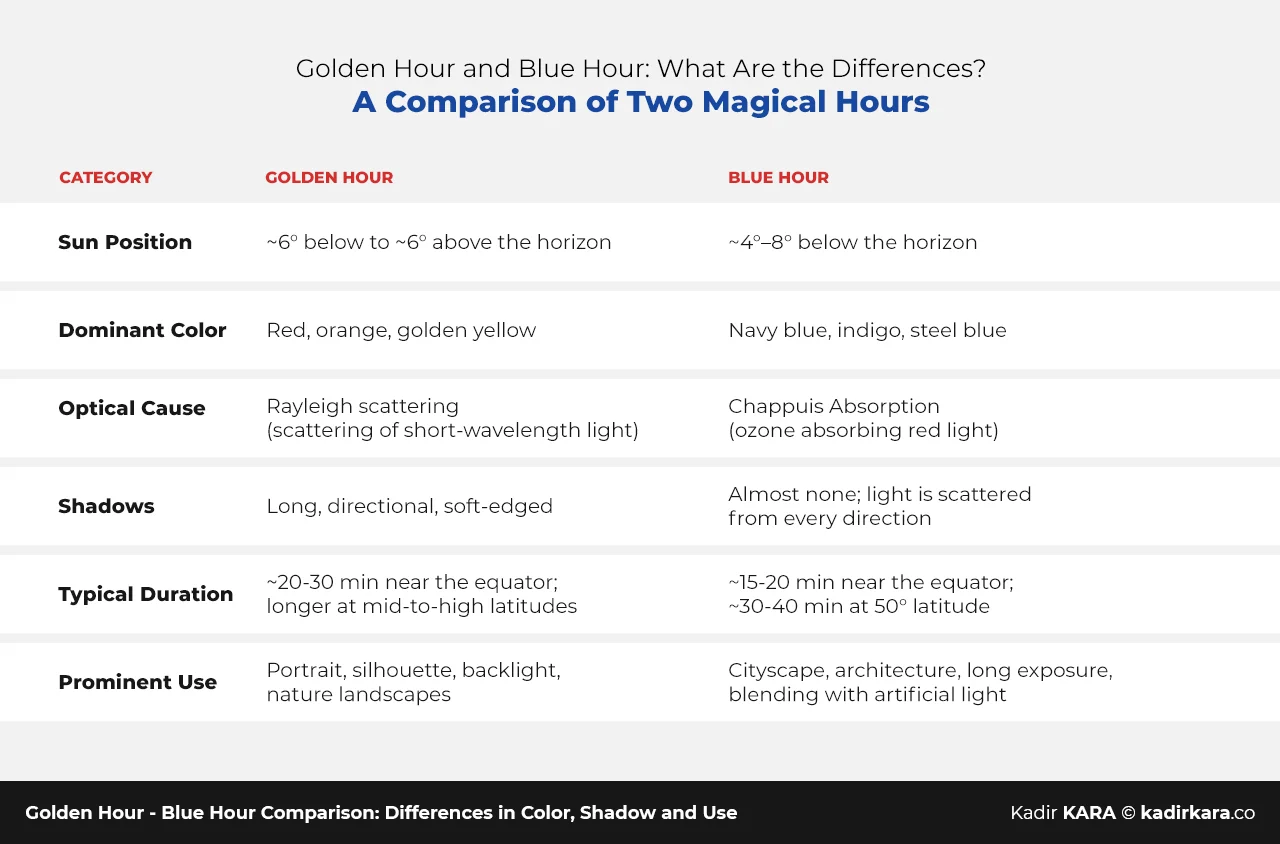
Golden Hour or Blue Hour? Which Light to Choose When
In practice, the choice generally depends on the feeling you want to convey. If you're looking for warmth, nostalgia, and energy, golden hour works; if you're looking for calm, mystery, and cinematic weight, blue hour works more powerfully. If you're planning a long shooting session, it's also possible to use both back to back. A flow that starts with golden hour and closes with blue hour offers two different atmospheres in a single session.
The Golden and Blue Hour Tradition in Cinema
In the film industry, this window is generally referred to as "Magic Hour." This term is used flexibly enough to sometimes bring golden hour and the start of blue hour together under the same roof.
The reason for this is that a scene can generally begin right before sunset and last into the first minutes of twilight, because the quality of natural light offers uninterrupted aesthetic continuity throughout this transition. However, this convenience also comes at a cost. Since the window is short, production crews spend most of the day on setup and rehearsal, while the actual shoot is squeezed into just a few dozen minutes. This is why outdoor scenes shot in natural light have produced some of the most difficult yet most talked-about visual achievements in the history of cinema.
Planning Tools and Practical Tips
Location Scouting
Location scouting should be done before the shoot. Once the light changes, you won't have time to experiment with composition.
Planning Apps
Apps that calculate sun position (such as PhotoPills) show in advance, minute by minute, when both golden hour and blue hour will start and end. This greatly reduces the risk of a "missed window."
Weather
Check the weather, but don't cancel. Thin, scattered clouds generally strengthen the effect; only dense, low cloud cover can completely block the horizon.
White Balance
Set your white balance manually. Automatic white balance may try to "correct" the warmth of golden hour or the coolness of blue hour, neutralizing the effect.
Common Mistakes
The most common mistake is overestimating the length of the window. Especially in regions close to the equator, this period is genuinely very short. The second common mistake is searching for a single "right moment"; whereas over the course of forty minutes, golden hour produces at least three to four different light qualities, and each one may be better suited to a different composition.
Finally, trying to shoot during blue hour without a tripod almost always ends in disappointment. In this low-light condition, stabilization is not a luxury but a necessity.
“The light constantly changes, and that alters the atmosphere
and beauty of things every minute.”
Claude Monet
A SHORT NOTE
I've been in this business for eighteen years, and I still get the same thought every time I hear the sentence "let's shoot in Golden Hour" in a brief: which golden hour, which minute of it? Because this forty-minute window doesn't offer a single light — it offers three or four different light qualities one after another, and choosing the right minute based on the brand's color and the product's texture is often the least talked-about but most critical decision in production.
This is exactly why I chose this topic: golden hour and blue hour are two phenomena that get brushed off as "nice light," but that actually carry a measurable, teachable physics and history. The difference that taking them a little more seriously makes to your shots is too significant to underestimate.
DID YOU KNOW? - 8 QUESTIONS 8 ANSWERS
Does a photographer living near the equator experience the same duration as someone living at the 60th latitude?
No. In regions close to the equator, golden hour is short because the sun sets at a nearly vertical angle; at high latitudes, this window lengthens noticeably because the sun descends toward the horizon at a much more oblique angle.
Does golden hour disappear completely on a cloudy day?
No; thin cloud layers can soften the light even further, creating a natural softbox effect. Only thick, low clouds can block the horizon and largely eliminate the effect.
Why do some photographers prefer blue hour over golden hour?
Because blue hour offers a rare balance where city lights and the brightness of the sky come close to each other. Without this balance, the sky in night shots turns out either pitch black or overly bright.
Why does a behind-the-camera crew work as if they were almost "racing" during golden hour?
Because the window can be shorter than forty minutes. Since the light changes minute by minute, the scene setup and camera settings need to be finished in advance.
What is the most common technical mistake made when shooting during blue hour?
Aggressively raising the ISO without sufficiently extending the exposure time. This flattens the subtle color transitions in the sky and makes the image noisy.
What is the practical difference between "Magic Hour" and "Golden Hour"?
Golden Hour has an approximate angle definition in photography; Magic Hour, on the other hand, is used more flexibly in film practice and can sometimes also cover the first minutes of blue hour.
Why do some landscape photographers prefer sunrise over sunset?
In the morning hours, the air is generally calmer and there is less wind. This ensures less atmospheric haze and clearer color transitions, but this isn't a rule that applies to every location.
Is it documented who first used the term "Magic Hour" and when?
No; the exact first use date and the person behind the term have not been reliably documented. Its common use today is associated with 20th-century film practice.
SOURCES
The Physical Definition of Golden Hour Photography and Sun Angle Calculations
The Optical Origin of Blue Hour and an Explanation of Chappuis Absorption
The Difference Between the Concept of "Magic Hour" in Cinema and Golden Hour


